
Remnant Prairie
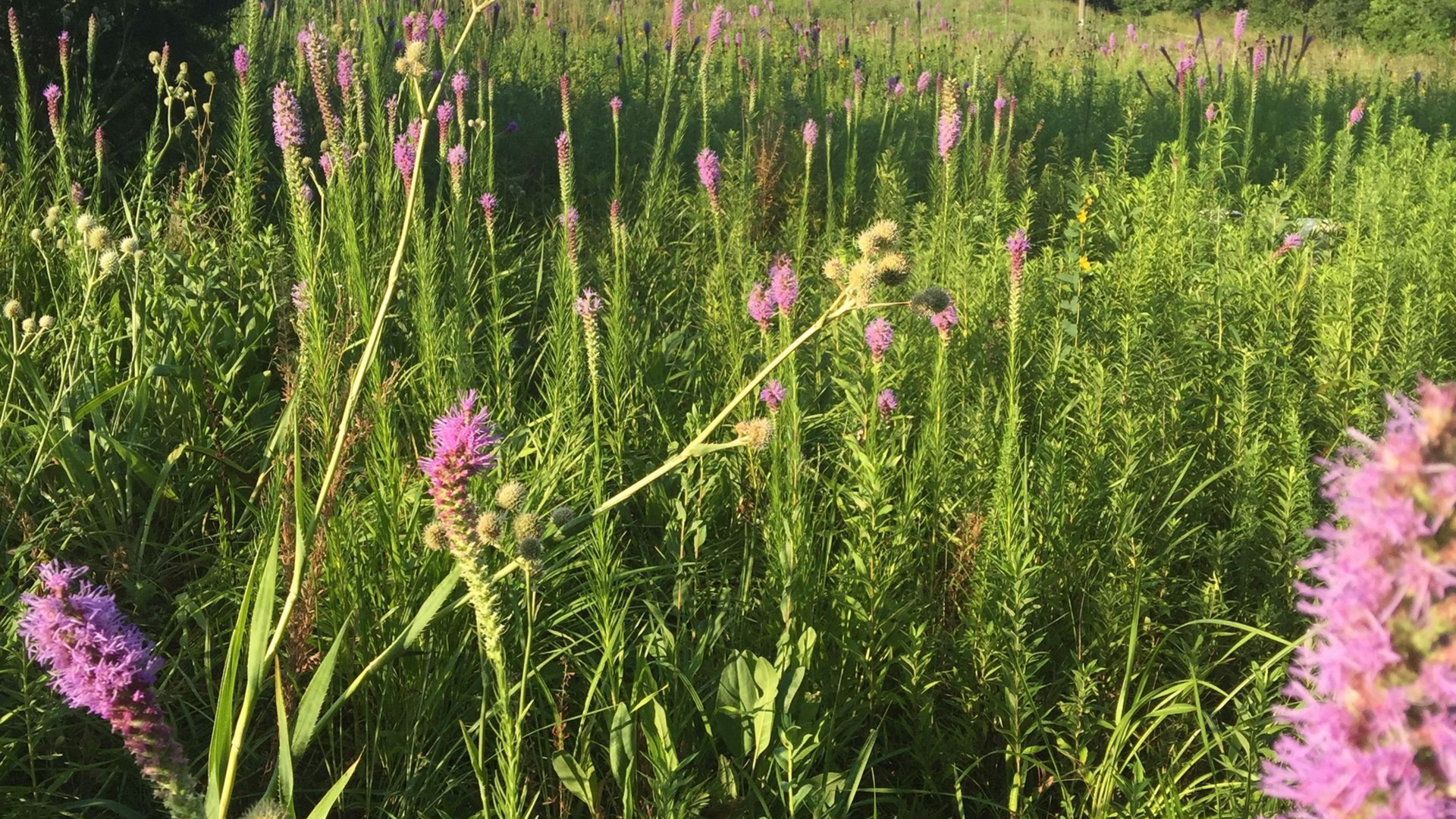
Prairie is an ecosystem dominated by grasses and non-woody broad-leaved plants (forbs) with less than 10 percent tree cover. Twelve specific prairie natural communities are found in Missouri, determined by geology, soils, moisture, hydrology, and topography, with each type expressing a different assemblage of plants and animals. A remnant prairie is an original, unplowed habitat, often much reduced from a larger, intact original landscape. *Content for this page provided by
Missouri Prairie Foundation*
What is Prairie?
Prairie is an ecosystem dominated by grasses and non-woody broad-leaved plants (forbs) with less than 10 percent tree cover. Twelve specific prairie natural communities are found in Missouri, determined by geology, soils, moisture, hydrology, and topography, with each type expressing a different assemblage of plants and animals. As with all ecosystems, many elements of a prairie—plants, animals, fungi, soil—are interdependent.
Tallgrass prairie occurs from the Flint Hills region of Kansas eastward through Missouri and all the way to Ohio. There are many grassland types in the eastern and southeastern United States as well, including prairies, savannas, open woodlands, glades, fens, stream scours, and coastal grasslands. Westward from the Flint Hills of Kansas (west of Wichita, KS), mixed-grass and short-grass prairie are the dominant prairie types. Prairie types developed with natural disturbances, including fire and grazing, and most are drought-tolerant.
Learn more about Specific Prairie Natural Communities here.
As prairie plants grow, most of the initial growth is below ground in deep root systems. Two-thirds of the living portion of the prairie is below ground in the roots. As fire burns across the land, it burns the dead material from the top of the plants, returning its nutrients to the earth. Fire eliminates most tree species from taking over a prairie. Prairie plants, which tolerate fire, then re-sprout from their deep roots. Over thousands of years, the continuous cycle of life and death on the prairie built the rich, deep soils of the Midwest. These root systems store significant amounts of atmospheric carbon, which is critically important in mitigating the harmful effects of climate change. These root systems also slow and trap stormwater, filtering pollutants in rainwater runoff and protecting streams. In addition, prairie soils harbor the most diverse soil microbial communities on earth, including mycorrhizal fungi, largely due to these root systems.
Learn more about Prairie Biodiversity, Including The Prairie Soil Microbiome, here.
How did Prairie Get in the Midwest?
Modern prairie
is 8,000 years
old, but it is millions of years in the making. As the glacial ice-sheets retreated from the Midwest 12,000 to 10,000 years ago, the climate gradually changed. As the forests retreated with the colder glacial climate, prairie became established in the warmer, drier climate. Forests have made advances into the prairie at different times in the past 8,000 years as the climate has changed. Fires kept most of the forest at bay. Certain trees could survive some of the fires and grew widely spaced on prairies, creating savannas. Rocky, open slopes within woodlands that contain native prairie species are called glades. Savannas and glades are other types of native grasslands. Historically Midwestern prairie fires were routinely set by Native American cultures (for a wide variety of reasons) and occasional lightning fires.
How much Prairie is Left in Missouri?
Today, less than 1/2 of 1% of native prairies remain in Missouri. Once covering at least 15 million acres in Missouri—one-third of the state—up until statehood in 1821, today, according to the Missouri Natural Heritage Database, fewer than 45,000 scattered acres of original, unplowed prairie remain. Approximately 18,000 of these remaining acres are protected by state agencies, the Missouri Prairie Foundation, The Nature Conservancy, and other groups. Many factors have contributed to the demise of the prairie, including land conversion for agricultural purposes and other human development, fire suppression, overgrazing, and invasive species.
“Presettlement Prairie” refers to prairies in Missouri and elsewhere in the United States prior to Euro-American settlement.
The following articles and other documents by Dr. Walter Schroeder provide details about presettlement prairie in Missouri:
• Creating a Prairie Map of Missouri, by Walter Schroeder, from the Missouri Prairie Journal, Volume 32, Number 3 & 4, 2011 (PDF 19MB) Published by the Missouri Department of Conservation
• The Presettlement Prairie in the Kansas City Region (Jackson County, MO) (PDF 13MB) Published in the Missouri Prairie Journal, Volume 7, Number 2, December 1985 (PDF 12MB) Published in the Missouri Prairie Journal, Volume 3, April 1981
Learn more about the History of Prairie in Missouri here.
Definitions
Remnant: an original, unplowed habitat, often much reduced from a larger, intact original landscape.
Restoration: enhancing a site that has been degraded by disturbances (e.g., overseeded with tall fescue and/or overgrazed, or invaded by trees), but has never been plowed.
Restoration of prairie remnants may involve dormant-season herbicide treatment of tall fescue, when native vegetation has died back, and will not be harmed by herbicide treatments, but on warm days in winter, tall fescue will absorb herbicide. Other non-woody plants that may invade prairie remnants include sericea lespedeza and Johnson grass, which may be controlled during the growing season. Learn more about controlling invasive plants at the Missouri Invasive Plant Council website.
Prairie remnants with invading woody plants may be restored by removing shrubs and trees.
When restoring prairie remnants, avoid soil compaction and disturbance. Limit driving vehicles on remnant prairies. Tree removal is best performed in winter, when the ground is frozen.
Reconstruction
Establishing a coarse replica of a natural community, like a prairie, from scratch on a previously row-cropped and plowed site, with a seeded planting. The current condition of a site before reconstruction could be tall fescue, row crops, or previously disturbed land containing native or non-native weedy vegetation.
In November 2019, an article published online in Restoration Ecology: “Are we close enough? Comparing prairie reconstruction chronosequences to remnants following two site preparation methods in Missouri, U.S.A.” underscores this point. Written by Chris Newbold, then Natural History Biologist with the Missouri Department of Conservation, and co-authors Benjamin Knapp and Lauren Pile with University of Missouri and the U.S. Forest Service (respectively), the article documents results of a study whereby diverse prairie plantings were established through reconstruction, but they did not reach the diversity or comparable species composition of nearby reference, remnant prairies. The article also stresses the importance of site preparation and improved seed collection and establishment techniques for more diverse reconstructions.
Protecting remnants is vital conservation work—because many elements of original prairie are irreplaceable. Establishing reconstructions is critical as well, to expand habitat for many species of grassland wildlife, improve health of watersheds, and store more carbon in the soil. Prairie reconstructions (plantings) also provide nutritious, drought-tolerant forage for cattle.
Between Grassland-Dependent Species And Prairie-Dependent Species here
Conservation Significance Of Remnant Prairies here.
Stewardship of Remnant Prairies
The best way to protect diverse, intact remnant prairie is with vigilant stewardship, to prevent loss of native biodiversity and degradation that would require intensive restoration. Year-round stewardship includes:
- Scouting for invasive plants several times during the growing season and promptly spot treating them with appropriate herbicide.
- Common Invasive Plants in Grasslands and Recommended Treatments here
- Invasive Species Control for Prairie and Native Grassland Conservation here.
- Regular prescribed burning.
- Prescribed Burning on Prairies here
- Plant and animal monitoring, including baseline surveys and monitoring populations of those species over time to ensure that stewardship is sustaining or even enhancing native biodiversity.
The Missouri Department of Conservation has developed a Community Health Index (CHI) tool for rapid monitoring of natural community response to management. In 2023, the Conservation Federation of Missouri passed a resolution in support of the CHI tool: Adoption of the Community Health Index and Implementation of Corrective Action Plans for Remnant Prairie Management Entities.
To learn how to use the CHI tool on remnant prairies, contact Missouri Department of Conservation Natural Community Ecologist Mike Leahy at
573-577-3192.
Prescribed Burning
One-third to one-half of a remnant prairie should be burned annually, rotating units each year. Dormant-season burning mimics historical timing of fire by Native Americans in Missouri and is ecologically important.
Learn more about the History of Fire in Missouri at this link
here.
Grazing
Prairie in Missouri evolved with disturbance, including fire and grazing by bison and other animals in varying intensities. Euro-American settlers in Missouri depended on prairie forage to feed livestock, and prairies in Missouri played an important role in the growth of the cattle industry in Missouri.
Prairie remnants can provide drought-tolerant, nutritious forage to cattle. On prairie plantings (not remnants) studies have shown that cattle gain more weight on 90 days of grazing prairie versus the same amount of grazing on fescue. Depending on stocking rate and grazing intensity, cattle grazing in combination with prescribed fire and or haying on prairies may be able to sustain native biodiversity of prairie- and grassland-dependent plants and animals, but must be done very carefully. However, overgrazing has caused the demise of thousands of acres of prairie in Missouri.
In year 10 (in 2025) of a 15-year Missouri Department of Conservation study on patch-burn-grazing with cattle of several remnant prairies in Missouri, the effects on prairie remnant-dependent plants and grassland birds were not clear-cut. Preliminary results do not offer any clear management direction.
The amount of acreage of remnant prairies is not adequate to sustain an economically viable cattle industry in Missouri. Prairie plantings, however, established on portions of fescue pasture or former row crops, can diversify forage systems for cattle producers and provide drought-tolerant, nutritious forage. With an estimated 14 million acres of tall fescue in Missouri, there is ample opportunity to convert a portion of it to native prairie plantings with benefits to cattle production, grassland birds, carbon storage, water quality, and rural economies.
Haying
Many remnant prairies in Missouri owned by private individuals have been hayed annually for decades. Haying prairies in summer tends to favor early spring wildflowers like paintbrush and prairie violets, which can decline in prairies overgrown with brush or invasive plants, or that are not regularly burned. Haying prairies during grassland bird nesting (May through early July) negatively impacts grassland bird populations. Haying during this time period also impacts pollinating insects and other animals.
Annual haying can suppress many plant and animals species on remnant prairies; ironically, however, haying has saved many prairie remnants from being plowed or otherwise converted, by providing a source of income to remnant prairie owners. Remnant prairies with a long haying history also are generally not impacted by invading shrubs and trees. Haying can be incorporated into a rotation with prescribed fire and rest periods that can provide periodic income for private landowners and yet not cause the same degree of problems that annual haying creates.
The Missouri Department of Conservation offers these guidelines regarding high quality prairie hay production.
1) Cut hay prairies in late June to early July to 3- to 4-inch stubble. While this timing will produce the highest quality prairie hay, keep in mind that wildlife will be negatively impacted--grassland birds are nesting on the ground at this time, and by mowing wildflowers, native pollinators will lose food and nesting resources.
2) Control weeds and brush by proper haying time and by burning in late spring (about April 15) two years in succession out of every five years.
3) Fertilize with 30 to 40 pounds of nitrogen per acre about mid-May and only in conjunction with burning. Consider fertilizer costs against anticipated value of increased forage produced.
4) Never graze prairie hayed in the same year until at least November and leave at least a 4-inch stubble. If possible, avoid winter grazing — forage quality is quite low.
5) Alternate haying and rest years for improved wildlife nesting cover.
6) Rotate haying with grazing.
You can find additional information on managing hay prairies at Kindscher-Byczynski-2009-Native-Prairie-Hay-Meadows.pdf